Impaired language processing is a core symptom of psychosis and is critically involved in shaping positive (e.g., auditory hallucinations) and negative symptoms (e.g., social withdrawal). Hierarchical Bayesian accounts of psychosis suggest an imbalance in the weighting of prior beliefs and incoming sensory information to be an underlying mechanism of symptom development.
Thus, in this project we are combining a novel predictive language paradigm (Fig. 1 A) and computational modelling (Fig. 1 A) to investigate
(1) whether predictive language processing is impaired across different stages of psychosis (i.e., at-risk, first episode, chronic schizophrenia), and
(2) whether these linguistic predictive processing mechanisms contribute to the perception of illusions (i.e., non-clinical hallucinations).
Additionally, we are using different neuroimaging methods (e.g., EEG, MRS spectroscopy, fMRI) to explore the underlying neurophysiological signatures of potential alterations.
In our predictive language paradigm, we use differently predictable sentence that end with expected or unexpected words which are degraded in clarity.
Here are some examples:
Highly predictable sentence and expected targets words in different noise degradations
Medium predictable sentence and targets words in different noise degradations
Highly unpredictable sentence and targets words in different noise degradations
Highly predictable sentence and unexpected targets words in different noise degradations
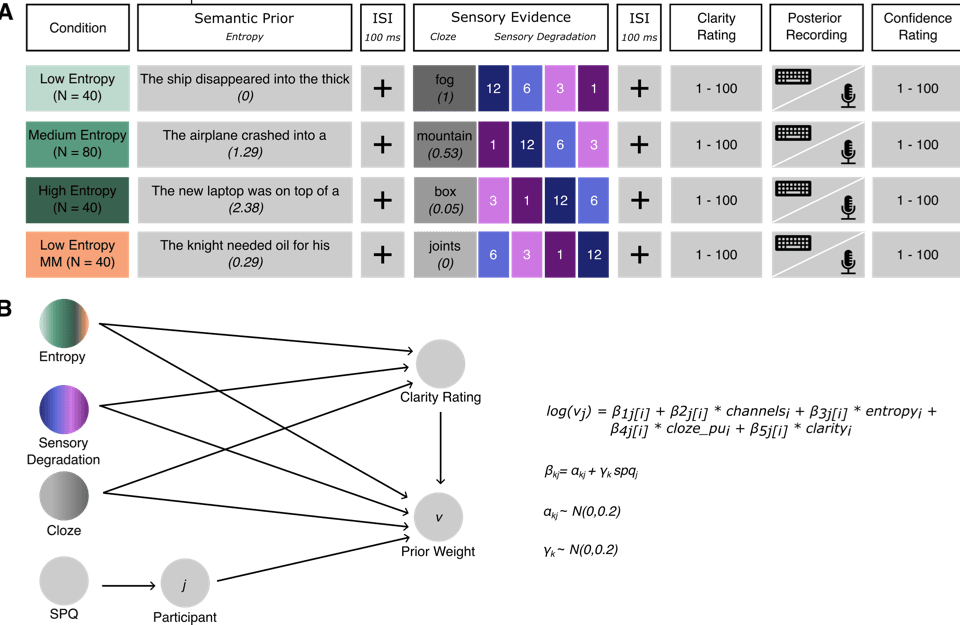
Fig. 1 The predictive language comprehension task and the corresponding Belief Updating model. A)Participants listened to a sentence via headphones. The sentence consisted of a sematic prior, measured in entropy (i.e., continuous measure of predictability; sentences were categorized in low, low mismatch (mm), medium and high entropy), and the sensory evidence which describes the noise vocoded target word, which was quantified using the word’s cloze probability and level of sensory degradation (i.e., numbers of channels for noise vocoding, 1 channel=unintelligible, 12 channels=highly intelligible). After the participants heard the target word, they rated the clarity of the target word (Likert scale: 0-100). Then participants were asked to write down or say (in replication study) the word they heard and rate how confident they were with their response (Likert scale: 0-100). Each participant completed 200 trials, each trial contained one sentence. B) Directed acyclic graph of the causal relationships between the trial- and population-level parameters and the individual effect, and the linear model for prior weight. The graph depicts a direct, individual effects model, which shows the linear contributions of the parameters to the estimation of the prior weight (nu). The participant effect (i.e., SPQ, j) directly affects the prior weight , and all trial parameters (i.e., entropy, channel number, cloze probability, i) are stratified by the individual clarity rating. Gamma and alpha are fitted in a mechanistic belief updating model and have a mean of 0 and a standard deviation of 0.2.
 franziskaknolle.com